This post may contain affiliate links which means I may receive a commission if you purchase something through my link. I only recommend things I have used and love.
There’s a familiar experience that many people describe as imposter syndrome. It often shows up as an inner voice that questions your right to be where you are, a tightening in the body when you’re about to be visible, or an almost reflexive urge to shrink, apologise, or over-explain. It can feel as though you’re constantly on the brink of being exposed as someone who doesn’t quite belong, someone who has somehow slipped through the cracks.
We’ve been taught that this experience is a confidence issue. A mindset issue. Something to be reframed, corrected, or overridden with more self-belief. But what if that framing is incomplete? What if what you’re experiencing isn’t a failure of confidence at all, but a physiological response to a perceived risk?
What if what we call imposter syndrome is actually your nervous system doing its best to protect you?
When you begin to look at this experience through a nervous system lens, the story shifts. What once felt like a personal flaw starts to make sense as a patterned response, rooted not in inadequacy, but in safety.
Imposter Syndrome as Patterned Protection
Imposter syndrome is usually treated as a cognitive problem. The solution, we’re told, is to change the narrative in your head, gather evidence of your competence, or remind yourself that everyone feels this way sometimes. While these approaches can be helpful on the surface, they often fail to address what is happening beneath the level of conscious thought.
For many people, the issue is not a lack of insight into their abilities, it’s a lack of safety in the body around being seen, recognised, or powerful.
When your nervous system has learned, over time, that visibility carries risk, it stores that information as a survival pattern. The moment you step into a new level of leadership, expression, or responsibility, your body responds as though you are entering dangerous territory. The response is automatic and protective. Self-doubt, people-pleasing, over-preparing, and the urge to hide are not character flaws. They are strategies your nervous system has used to keep you safe.
This is why imposter syndrome often appears precisely when you are growing. It’s not evidence that you’re unqualified, it’s evidence that your system is responding to expansion with caution.

Why the Nervous System Responds to Visibility as Threat
From a neurobiological perspective, the nervous system is constantly scanning for cues of safety and danger. This process, known as neuroception, happens without conscious thought. Your body assesses whether a situation feels predictable, supported, and manageable, or uncertain, exposing, and risky.
For many people, experiences earlier in life shaped how this system learned to interpret visibility. If speaking up was met with criticism, dismissal, or punishment, the body learned that expression was unsafe. If success led to resentment, withdrawal, or increased pressure, the nervous system learned to associate achievement with threat. If worth was conditional on performance, being seen without perfection may still feel dangerous.
These associations do not disappear simply because you grow older or more competent. They remain stored in the body as expectations. So when you prepare to share your work, raise your prices, or step into a leadership role, your nervous system reacts based on what it has learned before, not on what is objectively true now.
Feeling like a fraud in these moments is not a sign that you are one. It is a sign that your system is trying to prevent you from repeating an experience it once found overwhelming or painful.
Reframing Imposter Syndrome as a Call for Safety
When imposter syndrome is understood as a safety response rather than a confidence deficit, the internal conversation changes. Instead of asking what is wrong with you, the question becomes what your nervous system needs in order to feel supported.
This shift moves you out of self-blame and into self-attunement. Rather than fighting the sensation of doubt, you begin to listen to it as information. The goal is no longer to eliminate fear, but to increase your capacity to remain present and connected while fear exists.
As your nervous system experiences safety alongside visibility, something important happens. The association between being seen and being threatened begins to loosen. Over time, your system learns that expression doesn’t automatically lead to harm. Confidence grows not because fear has disappeared, but because safety has increased.
This is how imposter syndrome loses its grip. Not through denial or force, but through regulation and trust.
Why Imposter Syndrome Often Returns
Even after “doing the work!”
One of the most confusing aspects of imposter syndrome is how persistent it can feel. Many people reading this will have already done tons of personal development, therapy, mindset work, or somatic practices. They may intellectually understand their own worth, their skill, and their experience, and yet the moment they step into a new level of visibility or responsibility, the familiar sensations return. The doubt. The contraction. The urge to retreat.
This is where many people assume they’ve failed somehow, or that their healing hasn’t “worked.” In reality, what they’re experiencing isn’t regression, but expansion.
The nervous system doesn’t measure safety in absolutes. It measures safety in context. A situation that feels manageable at one level of exposure can feel threatening at the next. Each new edge - higher visibility, greater leadership, more success - represents unfamiliar territory, and unfamiliarity alone can be enough to activate protective responses.
This is why imposter syndrome often reappears not when you are doing something wrong, but when you are doing something new. The nervous system is responding to novelty, not incompetence. It’s recalibrating its understanding of what is safe based on past experiences, not current capability.
When this pattern is misunderstood, people often respond by doubling down on self-criticism or trying to “fix” the feeling as quickly as possible. But nervous-system-led growth requires a different response. It asks for patience, orientation, and integration. It asks you to recognise that confidence is not a destination you reach once, but a capacity that evolves alongside your expansion.
Seen through this lens, the return of imposter syndrome is not a sign that you should stop. It’s a signal that your system needs support to move with you into the next level, rather than being dragged there.
This reframing alone can soften the experience dramatically. Instead of spiralling into self-doubt, you begin to meet these moments with curiosity. Instead of assuming something is wrong, you recognise that your nervous system is simply learning how to hold more.
Supporting Your Nervous System Through Expansion
Working with imposter syndrome from a nervous-system-led perspective means pairing moments of courage with moments of support. Before stepping into situations that feel vulnerable or expansive, it becomes important to check in with the body rather than overriding it. This might involve noticing sensations of tension or activation and offering yourself grounding or reassurance before moving forward.
Growth also becomes more sustainable when it happens in tolerable increments. Confidence is built when the nervous system can integrate an experience without becoming overwhelmed. Small, manageable exposures that end with a sense of safety create far more lasting change than dramatic leaps that leave the body braced or shut down.
Equally important is what happens after moments of visibility. When the nervous system is allowed to settle and return to regulation, it learns that the experience has passed and that safety has been restored. Without this integration, the body remains on alert, reinforcing the very patterns you are trying to shift.
Over time, these experiences accumulate. The nervous system updates its expectations. Being seen begins to feel less threatening and more neutral, even supportive. Self-trust grows quietly and steadily.
This Isn’t a Confidence Problem, It’s a Safety Response
You do not need to silence your inner critic in order to lead or create. You need to stop abandoning yourself when that voice appears.
When imposter syndrome is recognised as a safety response, you can meet it with compassion rather than force. You stop searching for quick-fix confidence strategies and start building the internal conditions that allow confidence to emerge naturally.
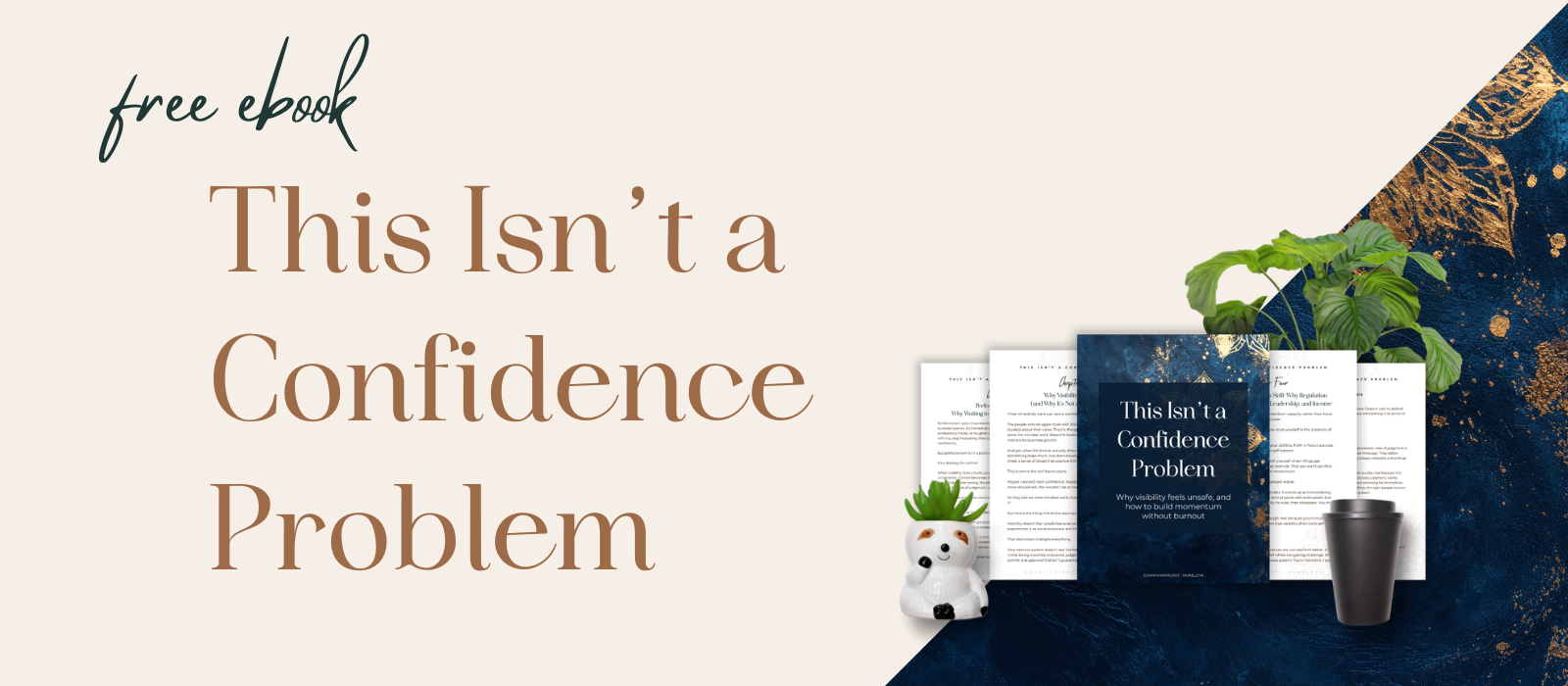
This is the work we explore in my free ebook, This Isn’t a Confidence Problem. It's an invitation to understand what’s happening beneath the surface and to build nervous-system-led self-trust that can hold the work you are here to do.