This post may contain affiliate links which means I may receive a commission if you purchase something through my link. I only recommend things I have used and love.
Self-doubt is an experience many people live with quietly. It doesn’t always announce itself loudly or dramatically. Often, it shows up as a subtle hesitation before you share something meaningful, a familiar tightening before you raise your prices, or a gentle but persistent thought that suggests you might need more time, more certainty, or more proof before you move forward.
It tends to appear right at the end of expansion – when an opportunity excites you and unsettles you in equal measure. And when it does, the message we’re usually given is to work harder on our mindset. To affirm our worth, push through the discomfort, or override the doubt with determination. Mindset work can be useful, but if it were enough on its own, self-doubt wouldn’t be such a recurring theme for so many capable, self-aware people.
What often goes unrecognised is that self-doubt isn’t just a habit of thought. It’s a state of the nervous system. It’s something that lives in the body as much as in the mind. And when confidence is pursued without understanding what the nervous system is doing beneath the surface, it tends to feel fragile, inconsistent, or short-lived.
Why Self-Doubt Isn’t Just a Mindset Problem
Self-doubt is frequently interpreted as evidence of inadequacy or a lack of readiness. In reality, it’s much more accurate to see it as a protective response. Your nervous system is designed to keep you safe, and it does so by constantly scanning for cues of potential threat. When it perceives risk – whether that risk is rejection, failure, judgment, or even success – it activates patterns intended to reduce exposure.
Earlier experiences shape how this system learns what is safe and what is not. If taking up space once led to criticism, conflict, or withdrawal of connection, the body may still associate visibility with danger. If success came with pressure or expectations you were not resourced to hold, expansion itself can feel unsafe. Over time, these associations become automatic, stored not as memories you can consciously recall, but as physiological responses that activate when similar conditions arise.
Neuroscience helps explain why this happens. When the brain senses a potential threat, the amygdala initiates a stress response, releasing hormones that prepare the body for fight, flight, freeze, fawn, or friend. This can happen even when the situation isn’t objectively dangerous. The nervous system responds to perceived risk, not rational evaluation. As a result, self-doubt often shows up as overthinking, avoidance, procrastination, or an inner critic that seems determined to keep you from stepping forward.
This is why logic alone resolves self-doubt. You can know that you are qualified. You can have experience, validation, and evidence of your competence. But if your nervous system hasn’t learned that this next level of visibility or responsibility is safe, confidence will continue to feel unstable. The issue isn’t a lack of belief in yourself; it’s a lack of internal safety.
Self-Trust as the Foundation of Confidence
One of the most helpful reframes in this work is understanding that confidence is not the starting point. It’s the outcome. What comes first is self-trust – not the kind that promises everything will go perfectly, but the kind that assures you that you can stay connected to yourself no matter what unfolds.
Self-trust is what allows the nervous system to tolerate uncertainty. It’s the felt sense that you can navigate discomfort without abandoning yourself. When self-trust is present, fear doesn’t disappear, but it becomes workable. You are no longer bracing against it or trying to eliminate it. You’re meeting it from a place of internal steadiness.
This is the heart of nervous-system-led confidence. It doesn’t rely on bravado or performance. It’s quiet, embodied, and resilient. Instead of asking whether you will succeed, your system learns that it can remain regulated regardless of the outcome. This is what allows you to take risks without collapsing, to be visible without losing yourself, and to grow without burning out.
Self-trust isn’t something you summon in a single moment. It’s built gradually, through consistent experiences of regulation, attunement, and repair. Each time you move toward something that matters and stay connected to your body in the process, you reinforce the message that you can expand safely.
Building Self-Trust Through Nervous System Regulation
Developing nervous-system-led self-trust begins with learning to listen to the body rather than overriding it. When self-doubt arises, it is an invitation to slow down and notice what is happening internally. Sensations of tightness, sinking, or agitation are signals that the nervous system is activated. Meeting these sensations with presence rather than judgment creates space for regulation.
From there, confidence grows through supported exposure. Instead of forcing yourself into situations that overwhelm your capacity, you move in increments that your system can integrate. Each step toward visibility or leadership is paired with regulation before, during, and after the experience. This allows the nervous system to register not just the activation, but also the return to safety.
Over time, these experiences accumulate. The body learns that discomfort doesn’t equal danger and that expansion doesn’t require self-abandonment. Self-trust strengthens as your system becomes familiar with its ability to move through uncertainty and come back to regulation. Confidence emerges not as a performance, but as a natural extension of this internal safety.
This Isn’t a Confidence Problem, It’s a Regulation Opportunity
When self-doubt persists despite your efforts, it’s not a sign that you need to push harder or prove yourself further. It’s often a sign that your nervous system is asking for more support. More regulation. More compassion. More space to integrate growth at a pace that feels safe.
This post may contain affiliate links which means I may receive a commission if you purchase something through my link. I only recommend things I have used and love.
There’s a familiar experience that many people describe as imposter syndrome. It often shows up as an inner voice that questions your right to be where you are, a tightening in the body when you’re about to be visible, or an almost reflexive urge to shrink, apologise, or over-explain. It can feel as though you’re constantly on the brink of being exposed as someone who doesn’t quite belong, someone who has somehow slipped through the cracks.
We’ve been taught that this experience is a confidence issue. A mindset issue. Something to be reframed, corrected, or overridden with more self-belief. But what if that framing is incomplete? What if what you’re experiencing isn’t a failure of confidence at all, but a physiological response to a perceived risk?
What if what we call imposter syndrome is actually your nervous system doing its best to protect you?
When you begin to look at this experience through a nervous system lens, the story shifts. What once felt like a personal flaw starts to make sense as a patterned response, rooted not in inadequacy, but in safety.
Imposter Syndrome as Patterned Protection
Imposter syndrome is usually treated as a cognitive problem. The solution, we’re told, is to change the narrative in your head, gather evidence of your competence, or remind yourself that everyone feels this way sometimes. While these approaches can be helpful on the surface, they often fail to address what is happening beneath the level of conscious thought.
For many people, the issue is not a lack of insight into their abilities, it’s a lack of safety in the body around being seen, recognised, or powerful.
When your nervous system has learned, over time, that visibility carries risk, it stores that information as a survival pattern. The moment you step into a new level of leadership, expression, or responsibility, your body responds as though you are entering dangerous territory. The response is automatic and protective. Self-doubt, people-pleasing, over-preparing, and the urge to hide are not character flaws. They are strategies your nervous system has used to keep you safe.
This is why imposter syndrome often appears precisely when you are growing. It’s not evidence that you’re unqualified, it’s evidence that your system is responding to expansion with caution.
Why the Nervous System Responds to Visibility as Threat
From a neurobiological perspective, the nervous system is constantly scanning for cues of safety and danger. This process, known as neuroception, happens without conscious thought. Your body assesses whether a situation feels predictable, supported, and manageable, or uncertain, exposing, and risky.
For many people, experiences earlier in life shaped how this system learned to interpret visibility. If speaking up was met with criticism, dismissal, or punishment, the body learned that expression was unsafe. If success led to resentment, withdrawal, or increased pressure, the nervous system learned to associate achievement with threat. If worth was conditional on performance, being seen without perfection may still feel dangerous.
These associations do not disappear simply because you grow older or more competent. They remain stored in the body as expectations. So when you prepare to share your work, raise your prices, or step into a leadership role, your nervous system reacts based on what it has learned before, not on what is objectively true now.
Feeling like a fraud in these moments is not a sign that you are one. It is a sign that your system is trying to prevent you from repeating an experience it once found overwhelming or painful.
Reframing Imposter Syndrome as a Call for Safety
When imposter syndrome is understood as a safety response rather than a confidence deficit, the internal conversation changes. Instead of asking what is wrong with you, the question becomes what your nervous system needs in order to feel supported.
This shift moves you out of self-blame and into self-attunement. Rather than fighting the sensation of doubt, you begin to listen to it as information. The goal is no longer to eliminate fear, but to increase your capacity to remain present and connected while fear exists.
As your nervous system experiences safety alongside visibility, something important happens. The association between being seen and being threatened begins to loosen. Over time, your system learns that expression doesn’t automatically lead to harm. Confidence grows not because fear has disappeared, but because safety has increased.
This is how imposter syndrome loses its grip. Not through denial or force, but through regulation and trust.
Why Imposter Syndrome Often Returns
Even after “doing the work!”
One of the most confusing aspects of imposter syndrome is how persistent it can feel. Many people reading this will have already done tons of personal development, therapy, mindset work, or somatic practices. They may intellectually understand their own worth, their skill, and their experience, and yet the moment they step into a new level of visibility or responsibility, the familiar sensations return. The doubt. The contraction. The urge to retreat.
This is where many people assume they’ve failed somehow, or that their healing hasn’t “worked.” In reality, what they’re experiencing isn’t regression, but expansion.
The nervous system doesn’t measure safety in absolutes. It measures safety in context. A situation that feels manageable at one level of exposure can feel threatening at the next. Each new edge – higher visibility, greater leadership, more success – represents unfamiliar territory, and unfamiliarity alone can be enough to activate protective responses.
This is why imposter syndrome often reappears not when you are doing something wrong, but when you are doing something new. The nervous system is responding to novelty, not incompetence. It’s recalibrating its understanding of what is safe based on past experiences, not current capability.
When this pattern is misunderstood, people often respond by doubling down on self-criticism or trying to “fix” the feeling as quickly as possible. But nervous-system-led growth requires a different response. It asks for patience, orientation, and integration. It asks you to recognise that confidence is not a destination you reach once, but a capacity that evolves alongside your expansion.
Seen through this lens, the return of imposter syndrome is not a sign that you should stop. It’s a signal that your system needs support to move with you into the next level, rather than being dragged there.
This reframing alone can soften the experience dramatically. Instead of spiralling into self-doubt, you begin to meet these moments with curiosity. Instead of assuming something is wrong, you recognise that your nervous system is simply learning how to hold more.
Supporting Your Nervous System Through Expansion
Working with imposter syndrome from a nervous-system-led perspective means pairing moments of courage with moments of support. Before stepping into situations that feel vulnerable or expansive, it becomes important to check in with the body rather than overriding it. This might involve noticing sensations of tension or activation and offering yourself grounding or reassurance before moving forward.
Growth also becomes more sustainable when it happens in tolerable increments. Confidence is built when the nervous system can integrate an experience without becoming overwhelmed. Small, manageable exposures that end with a sense of safety create far more lasting change than dramatic leaps that leave the body braced or shut down.
Equally important is what happens after moments of visibility. When the nervous system is allowed to settle and return to regulation, it learns that the experience has passed and that safety has been restored. Without this integration, the body remains on alert, reinforcing the very patterns you are trying to shift.
Over time, these experiences accumulate. The nervous system updates its expectations. Being seen begins to feel less threatening and more neutral, even supportive. Self-trust grows quietly and steadily.
This Isn’t a Confidence Problem, It’s a Safety Response
You do not need to silence your inner critic in order to lead or create. You need to stop abandoning yourself when that voice appears.
When imposter syndrome is recognised as a safety response, you can meet it with compassion rather than force. You stop searching for quick-fix confidence strategies and start building the internal conditions that allow confidence to emerge naturally.
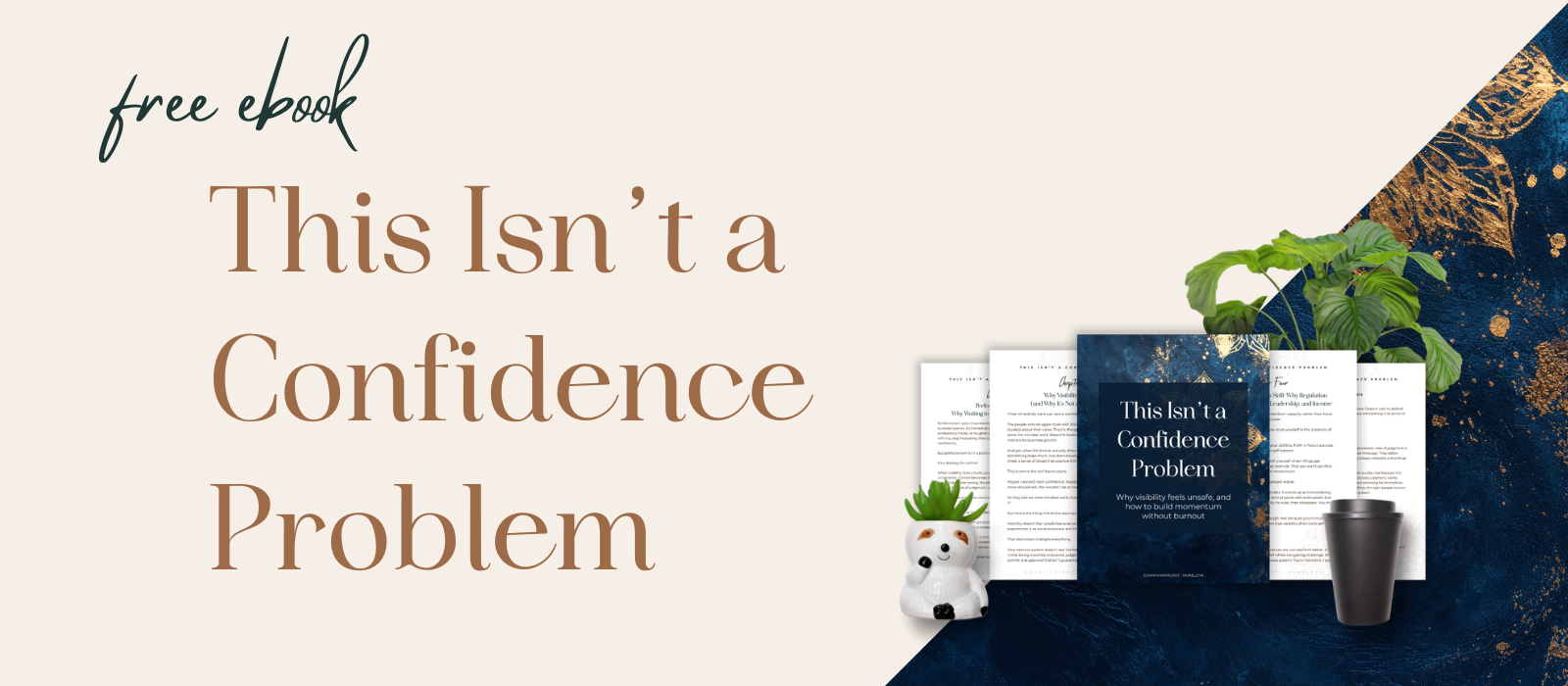
This is the work we explore in my free ebook, This Isn’t a Confidence Problem. It’s an invitation to understand what’s happening beneath the surface and to build nervous-system-led self-trust that can hold the work you are here to do.
This post may contain affiliate links which means I may receive a commission if you purchase something through my link. I only recommend things I have used and love.
There is a version of confidence that many of us have been taught to aspire to. It’s loud, unshakeable, and visibly fearless. It takes up space without hesitation, speaks without doubt, and powers through resistance with a smile. From the outside, it looks impressive. From the inside, it often relies on pressure, performance, and a quiet disconnection from the body.
For many people, that version of confidence isn’t accessible. Not because they’re lacking ambition, discipline, or belief in themselves. It’s inaccessible because their nervous system doesn’t feel safe enough to support it. And no amount of affirmations, mindset work, or pretending will override that reality for long.
Real, lasting confidence doesn’t come from forcing yourself forward. It comes from regulation. It comes from creating enough internal safety that your system can expand into something new without interpreting that expansion as a threat. Confidence that lasts is not built through pressure, it’s built through relationship with your body and its signals.
If you’ve been trying to push yourself into confidence and wondering why it isn’t working, it’s worth pausing here. Not to judge or diagnose yourself, but to reframe what confidence actually is, and how it can be built in a way that your nervous system, your life, and your business can sustain.
Confidence Through a Nervous System Lens
Confidence is not a personality trait you either have or don’t have. It’s a felt sense of safety in motion. When your nervous system perceives a situation as manageable, you are more able to show up fully, speak clearly, take risks, and hold your boundaries. When it perceives the same situation as dangerous or overwhelming, it will pull you back – not as a punishment, but as protection.
From a nervous-system-led perspective, building confidence is really about building capacity. Capacity to remain present when things feel uncertain. Capacity to tolerate exposure without spiralling. Capacity to stay connected to yourself while taking up space. None of this is about positive thinking or willpower. It’s biological.
This is why traditional confidence advice often falls short. Encouragement to “feel the fear and do it anyway” can lead to brief moments of expansion, but they are often followed by exhaustion, shutdown, or burnout. Telling yourself to believe in yourself more does very little if your body doesn’t feel safe being seen. When the nervous system is activated, it will always prioritise protection over performance.
Confidence grows not when fear disappears, but when the nervous system learns that fear doesn’t always equal danger.
The Cost of Pushing Through
We live in a culture that celebrates pushing through discomfort. Hustle, toughness, self-reliance, and performance are often framed as markers of confidence. For many people – especially those with a history of trauma, chronic stress, or early responsibility – this messaging reinforces a habit of overriding internal signals in order to meet external expectations.
If you were praised for being capable, independent, or high-achieving, you may have learned that confidence means doing hard things without support and without visible impact. But this version of confidence is built on disconnection. It requires ignoring the body’s cues and suppressing the very signals that are meant to keep you regulated.
You can build short-term momentum this way, but it rarely lasts. Eventually, the nervous system responds with fatigue, resistance, or shutdown. This isn’t failure, it’s the body restoring balance after too much override.
Sustainable confidence doesn’t come from pushing harder. It comes from learning when to pause, how to resource yourself, and how to integrate safety so that expansion becomes possible without collapse.
Trauma-Informed Confidence and Internal Safety
A nervous-system-led approach to confidence starts with listening rather than overriding. It means paying attention to the signals your body sends and responding with curiosity instead of judgment. It means recognising that fear isn’t the enemy, but information.
Trauma-informed confidence doesn’t demand that you leap beyond your capacity. It invites you to build capacity gradually, in ways your system can integrate. This might look like speaking even when your voice shakes, while staying connected to your breath. It might look like being visible without forcing yourself to perform. It might look like resting when your system needs it, even when your mind insists you should be doing more.
This kind of confidence doesn’t always look dramatic or bold from the outside. Often, it looks subtle and steady. Over time, however, it creates something far more resilient than performance-based confidence ever could. Because it’s rooted in internal safety rather than external validation.
As your nervous system learns that it can tolerate exposure without danger, confidence begins to emerge naturally. You stop chasing it. You stop forcing it. You begin to inhabit it.
Confidence as an Emergent State, Not a Goal
When confidence is built through nervous system regulation, it becomes something you grow into rather than something you strive for. It develops as your body learns that being seen, heard, and expressed doesn’t lead to harm. This process cannot be rushed, but it can be supported.
The more internal safety you build, the more space you have for clarity, expression, and leadership. Confidence becomes less about providing yourself and more about trusting your capacity to meet what arises. It becomes quieter, steadier, and far more sustainable.
How Nervous-System-Led Confidence Is Actually Built
Nervous-system-led confidence is not something you switch on through intention alone. It’s built through repealed experiences of safety in moments that previously felt threatening. In other words, confidence emerges as your nervous system learns, over time, that you can be visible, expressive, and in motion without something bad happening.
This begins with regulation rather than exposure. So many people attempt to build confidence by throwing themselves into situations that overwhelm their capacity, hoping they will eventually desensitise. While exposure can be useful, it’s only effective when the nervous system has enough baseline regulation to process the experience without becoming flooded. Without that foundation, repeated exposure often reinforces fear rather than resolving it.
Nervous-system-led confidence is built by first increasing your body’s sense of internal safety. This involves learning how to settle the nervous system before, during, and after moments of visibility or risk. When your system can return to regulation after activation, it begins to trust that expansion does not equal danger. Over time, this trust becomes the ground from which confidence grows.
In practical terms, this means learning to notice when your body is moving into fight, flight, freeze, fawn, or friend, and responding with support rather than self-criticism. Instead of asking yourself why you feel afraid, the question becomes whether your system has what it needs to feel safe enough to stay present. Confidence develops as your capacity to remain connected to yourself during discomfort increases.
Another key aspect of nervous-system-led confidence is pacing. Confidence cannot be rushed without consequences. Expansion needs to happen in increments that your system can integrate. This might look like choosing visibility that stretches you slightly rather than overwhelms you completely, and allowing time for your nervous system to settle afterwards. Integration is just as important as action. When the body has space to process, it updates its understanding of safety.
Confidence is also shaped by relationships. Nervous systems regulate more easily in environments where there is consistency, attunement, and support. This is why confidence often grows faster when people feel seen and met rather than judged or pushed. Whether through safe relationships, supportive containers, or guided nervous system work, relational safety plays a significant role in helping the body relax its defences.
Over time, these repeated experiences of safety accumulate. The nervous system begins to expect that visibility will not lead to collapse, rejection, or overwhelm. Confidence no longer requires effort or performance. It becomes a natural byproduct of regulation, capacity, and trust in your ability to meet what arises.
This is why nervous-system-led confidence feels different from confidence built on willpower. It is quieter, steadier, and more sustainable. It doesn’t depend on being fearless. It depends on being resourced.
Three Practices That Support Nervous-System-Led Confidence
Understanding nervous-system-led confidence is one thing. Living it is another. What allows confidence to move from concept into lived experience isn’t dramatic action, but consistent, supportive practices that help the body learn safety over time. These practices aren’t about fixing yourself or forcing change, they are about creating the conditions in which confidence can emerge naturally.
Regulate before asking yourself to be brave The first practice is learning to regulate before you ask yourself to be brave. Many people wait until they are already overwhelmed before attempting to calm their nervous system, but confidence grows more easily when regulation comes first. Before moments of visibility, decision-making, or expression, it’s helpful to orient your body towards safety. This might involve slowing your breath, grounding through your senses, or simply allowing your nervous system to settle before taking action. When regulation precedes exposure, your body receives a clear signal that you are not rushing into danger. Over time, this changes how the nervous system anticipates similar situations in the future.
Confidence through tolerable increments The second practice is expanding confidence through tolerable increments rather than leaps. Nervous systems build capacity gradually. When you consistently ask yourself to take steps that exceed your system’s ability to integrate, confidence doesn’t grow, it fractures. Instead, confidence strengthens when you choose actions that stretch you slightly while still allowing you to remain present. This could look like sharing your voice in ways that feel manageable rather than overwhelming, or allowing yourself to be seen in contained environments before stepping into larger ones. Each experience that ends without collapse becomes evidence of safety, and your nervous system updates accordingly.
Integration after exposure The third practice is integration after exposure. Confidence doesn’t only form in the moment of action, it is consolidated after. So what you do after your moments of visibility matters a lot! When the nervous system has space to settle following visibility or risk, it learns that activation doesn’t always equal danger. This might involve consciously slowing down after a challenging conversation, allowing your body to rest after being seen, or gently reconnecting with sensations of safety once the moment has passed. Without this integration, the nervous system remains on alert, and confidence cannot fully take root. With it, the body learns that it can move through uncertainty and return to regulation.
These practices work not because they eliminate fear, but because they teach the nervous system that fear can be met without abandonment. Confidence, in this sense, becomes less about how bold you appear and more about how resourced you feel internally. The more consistently your system experiences regulation before, during, and after moments of expansion, the more confidence becomes a natural state rather than something you have to summon.
This Isn’t a Confidence Problem, It’s a Safety Problem
If confidence has felt elusive despite all your efforts, there is nothing wrong with you. You’re not blocked or broken. You may simply be trying to build confidence on a foundation that does not yet feel safe.
That is something that can be worked with.
This is exactly why I created This Isn’t a Confidence Problem– to help you understand what is happening beneath the surface and to offer a nervous-system-led framework for building confidence that feels grounded, embodied, and real.
This post may contain affiliate links which means I may receive a commission if you purchase something through my link. I only recommend things I have used and love.
Selling is supposed to be simple. Or so we’re told.
You have something valuable, someone else needs it, and selling is just the bridge between the two. In theory, it should feel natural, even generous.
And yet, for many heart-led business owners, selling feels anything but simple. It can feel exposing, heavy, and deeply uncomfortable. You believe in your work, you care about the people you want to serve, but when it’s time to talk about your offer, something in your body tightens. You hesitate, overthink, soften your language, or avoid the conversation altogether.
This is usually framed as a confidence issue. A mindset problem. A sign that you need to “get better at selling.”
But that explanation doesn’t go far enough.
What’s really happening has very little to do with confidence, and everything to do with safety.
More specifically, it has to do with what your nervous system has learned about being visible, being evaluated, and risking rejection in exchange for money. And if selling feels hard despite your genuine desire to help, you’re not alone.
The Hidden Layer of Resistance
When selling triggers anxiety, shutdown, or avoidance, it isn’t because you lock belief in your work, it’s because selling activates a nervous system response.
In a personal brand or service-based business, selling isn’t just transactional. You’re not offering an object that exists separately from you. You’re offering your ideas, your perspective, your experience, your energy. In many cases, you’re offering transformation. That level of personal investment makes selling inherently vulnerable.
From a neurobiological standpoint, your nervous system is constantly scanning for safety. This process happens beneath conscious awareness and is shaped by everything you’ve lived through. If asking for attention, receiving money, or putting your work forward has ever been met with criticism, rejection, shame, or even subtle disapproval, your body remembers that.
Not as a story, but as a felt experience.
When a similar situation arises, your nervous system reacts as if the threat is happening again. Your heart rate may increase, your breathing may become shallow, your thoughts may fragment or loop. You might feel suddenly tired, anxious, irritable, or disconnected.
This process is known as neuroception – the nervous system’s ability to detect safety or danger without consulting the rational mind. It means that even if you intellectually know your offer is valuable and aligned, your body may still respond as though selling is risky.
From the nervous system’s perspective, it’s not trying to sabotage you, it’s trying to protect you.
The Evolutionary Roots of Selling Stress
This stress response isn’t irrational, it’s deeply wired.
Humans evolved as social beings whose survival depended on belonging. Acceptance by the group means access to safety and resources. Rejection or exclusion could carry serious consequences. Because of this, the nervous system, developed sophisticated systems for detecting social threat.
Selling, at its core, involves evaluation. You’re inviting others to assess your value, decide whether you’re worth listening to, and determine whether what you offer is worth their resources. From an evolutionary lens, this is a high-stakes situation.
Whether one person says no or an entire audience doesn’t respond, the brain doesn’t make fine distinctions. The same threat-detection centres activate regardless. The amygdala responds as though social rejection poses a genuine risk, even when the logical mind knows otherwise.
This is why selling can feel disproportionately intense. You may find yourself reacting strongly to a lack of engagement or a declined offer, even when you know it isn’t personal. The nervous system is responding based on ancient survival logic that hasn’t updated for modern business contexts.
Why Heart-Led Selling Can Feel Especially Exposing
For people who lead with empathy, authenticity, and connection, selling often carries an extra layer of vulnerability. You aren’t promoting something detached from you. You’re inviting people into work that matters deeply to you. You’re sharing your perspective, your values, and often your personal story.
When someone says no, or nothing at all, it can land as a rejection of you, not just the offer. Even when you intellectually understand that this isn’t true, your body may still experience it that way.
Over time, this can create a familiar cycle. You avoid selling to protect yourself from discomfort. Your business growth slows. Self-doubt creeps in. Selling feels even heavier the next time around. The cycle repeats.
This isn’t resolved by pushing hard or “being more confident.” It’s resolved by helpding the nervous system feel safe enough to stay present during the act of selling.
What Selling With Safety Actually Looks Like
Making selling feel safer doens’t mean eliminating all discomfort. Some level of vulnerability is inevitable when you put yourself forward. The goal isn’t to erase sensation, it’s to build the internal capacity to stay regulated while sensation is present.
When your nervous system begins to register selling as tolerable (or even safe!) something shifts. You stop bracing against the experience. You speak more clearly. You show up more consistently. You stop apologising for your prices or over-explaining your value.
Most importantly, you stop abandoning yourself in the process.
This shift happens through nervous-system regulation, embodiment practices, and compassionate awareness of your patterns. Rather than forcing yourself through fear, you begin to gently update what your body believes about selling. The association moves from danger towards neutrality, and eventually towards possibility.
Selling stops feeling like exposure and starts feeling like communication. An invitation. A sharing of what you offer with those who are already looking for it.
This Isn’t a Confidence Problem, It’s a Safety Problem
If selling has ever made you want to disappear, procrastinate, or throw your phone across the room, there is nothing wrong with you. Your nervous system is responding exactly as it was designed to, based on what it has learned.
The important thing to know is that wiring is not destiny. Nervous systems are adaptable. Patterns can change. Safety can be built.
That’s why I created This Isn’t a Confidence Problem– a free ebook that explores the deeper nervous-system layers behind fear, resistance, and shutdown in business, and offers practical ways to work with them rather than against them.
This post may contain affiliate links which means I may receive a commission if you purchase something through my link. I only recommend things I have used and love.
There’s a very particular tension that sits at the heart of visibility. You want to be seen, to share your voice, your work, and what you know you’re here to offer.
And yet, as you move closer to doing that, something in your body resists. Your chest tightens, your thoughts become louder and more critical, and your nervous system reacts as though you’re stepping into danger rather than opportunity.
This experience is often mislabelled as a lack of confidence or motivation, but that framing misses what’s actually happening. The discomfort around being seen isn’t a personal failing. It’s deeply human, shaped by biology, evolutionary survival mechanisms, early relational experience, and the social environments we now live and work in.
When visibility feels unsafe, it’s not because something is wrong with you, it’s because your nervous system is responding exactly as it was designed to.
The Biological Roots of Fear: Your Brain Is Trying to Keep You Alive
To understand why visibility can provoke such a strong internal response, it helps to look at how the nervous system evolved.
Human brains didn’t develop in the modern world or online spaces. They evolved in environments where being seen carried real risk. Exposure could mean attracting predators, losing the protection of the group, or becoming vulnerable to attack. In that context, visibility wasn’t neutral, it was potentially life-threatening.
Because of this, the nervous system became highly attuned to uncertainty. When the brain cannot accurately predict the outcome of a situation, it often categorises that uncertainty as a possible threat. Sharing something personal, expressing an opinion publicly, or placing yourself in a position where you may be judged all carry an element of unpredictability. From the nervous system’s perspective, that unpredictability is enough to activate survival responses, even when there is no immediate physical danger present.
This activation happens automatically, not consciously. Stress hormones are released, attention narrows, and the body prepares to protect itself through fight, flight, freeze, fawn, or friend. This response doesn’t mean your nervous system is malfunctioning. It means it’s doing what it’s always done – prioritising safety over expression, survival over visibility.
In other words, when being seen feels unsafe, it’s not because your brain is trying to make things difficult for you. It’s because it’s trying to keep you alive… using very old rules in a very new world.
Why Humans Are Wired for Social Safety and Why That Can Trigger Fear
Humans didn’t survive through physical strength alone. We survived because we stayed connected. Belonging to a group meant access to protection, shared resources, warmth, and care. Being excluded or rejected carried serious consequences, and the nervous system adapted accordingly.
As a result, the human brain doesn’t only monitor for physical danger. It’s constantly scanning for social threats, too. The possibility of rejection, criticism, loss of status, or exclusion can activate the same survival circuitry that once protected us from physical harm. From an evolutionary perspective, this made sense. Avoiding behaviours that could jeopardise social belonging was an adaptive strategy.
This is why social anxiety and fear of evaluation are not irrational quirks or personal weaknesses. They are rooted in mechanisms designed to keep us connected and safe. When you anticipate being judged or evaluated – especially in a public context – your nervous system may interpret that anticipation as a risk to belonging, and therefore to survival.
So, when visibility triggers fear, it isn’t because you’re overly sensitive. It’s because your nervous system is responding to perceived social threats with the same seriousness it once reserved for physical danger.
The Nervous System Doesn’t Distinguish Between Old Dangers and Modern Visibility
One of the challenges of modern life is that the nervous system has not evolved at the same pace as our environment. Neurobiologically, the brain processes anticipated social evaluation in ways that closely resemble how it processes physical threat. The amygdala and related emotional processing centres respond to imagined criticism, rejection, or even silence as much as they would respond to tangible danger.
This is why visibility stress often shows up physically. You might notice your heart rate increasing, your breathing becoming shallow, your thoughts narrowing or looping, or your body tensing without clear reason. You may experience brain fog, heightened self-monitoring, or a sudden urge to perfect or withdraw altogether.
These reactions are not signs that you’re weak or incapable. They are physiological safety responses that are simply out of sync with the reality of modern visibility. Your nervous system is reacting to what it perceives as a threat, not to what your rational mind knows to be safe.
How Modern Social Environments Amplify the Fear of Being Seen
The online world intensifies this mismatch. Social media and online platforms expose us to constant visibility without the relational cues that historically helped regulate our nervous system. There is no immediate feedback to signal safety, no facial expressions to convey warmth, and no shared context to soften interpretation.
Instead, visibility becomes abstract and continuous. Posts are met with metrics rather than human response. Comparison is constant. Silence can feel loaded with meaning. Over time, this can create a feedback loop where the nervous system remains on high alert, scanning for evaluation even in the absence of overt threat.
Social media doesn’t create fear of being seen for nothing, but it does amplify existing sensitivities. It offers visibility without containment, exposure without relational buffering, and evaluation without context, all of which can increase nervous system activation.
Developmental Experiences Shape How Visibility Feels in the Body
Your personal history plays an important role as well. Early experiences of being seen (or not seen) shape how your nervous system learned to associate visibility with safety or danger. Experiences of criticism, shaming, ridicule, emotional neglect, or inconsistent attunement teach the nervous system what to expect when attention is directed your way.
If speaking up led to punishment or dismissal, your body may have learned that visibility equals risk. If vulnerability was met with silence or withdrawal, exposure may still feel unsafe for years later. These associations are not stored as conscious memories alone; they are encoded in the nervous system as expectations.
As an adult, this can show up as an automatic stress response when you are visible, even when your current environment is objectively safe. This isn’t regression or weakness. It’s the nervous system responding based on what it learned earlier in life.ut stress, overwhelm, or nervous system overload clouting your natural gifts.
Why Confidence Isn’t the Problem, Safety Is
This brings us to a crucial point: confidence alone doesn’t resolve fear. Safety does.
Much of the advice around visibility encourages us to just push through the discomfort, reframing thoughts, or cultivating confidence through repetition. While these strategies can be helpful at times, they often fail when the nervous system is signalling threat. Willpower and positive thinking cannot override a system that doesn’t feel safe.
The real issue is not a lack of courage or belief in yourself. It’s a mismatch between what your rational mind understands and what your nervous system perceives. When your body interprets visibility as risk, it will prioritise protection over expression, regardless of how much you want to show up.
Change happens not by forcing bravery, but by helping the nervous system update its understanding of safety. This involves recognising how uncertainty activates survival responses, understanding how social threat is wired into the brain, acknowledging the impact of past experiences, and working with, rather than against, the body’s protection mechanisms.
This Isn’t a Confidence Problem, It’s a Nervous System Mismatch
If visibility has felt harder than it “should,” this perspective offers a different explanation. Your nervous system is not working against you. It’s responding based on what it has learned about risk, belonging, and safety. The good news is that these patterns are not fixed.
The nervous system can learn new associations. With the right support and regulation, visibility can begin to feel less like a threat and more like a possibility.
That’s exactly why I createdThis Isn’t a Confidence Problem – a free ebook that explores these dynamics in depth and offers practical, nervous-system-informed tools to help you shift your relationship with visibility.
Download your free ebook below to begin creating safety around being seen.
This post may contain affiliate links which means I may receive a commission if you purchase something through my link. I only recommend things I have used and love.
You know that feeling when your brain seems to be running a hundred tabs at once, your to-do list is longer than your arm, and every decision – even the small ones – feels weirdly monumental?
You’re trying to focus, but your thoughts keep jumping. You want to take action, but everything feels heavy. You’re doing all the right things, yet you still feel scattered, tense, and quietly overwhelmed.
That’s what I call the frazzled state – and if you’re an online business owner or creative, chances are you know this feeling REALLY well.
Most of us try to think our way out of it. We make more lists, drink more coffee, push harder, and tell ourselves to “just get on with it.”
But what if the solution isn’t in your head at all?
What if clarity and confidence aren’t things you need to figure out, but states your body needs to feel safe enough to access?
Welcome to somatic healing, where your nervous system becomes your secret weapon for thriving, not just surviving.
What’s Really Happening When You Feel Frazzled?
When you’re constantly juggling clients, content, income, and creative output, your nervous system can get stuck in a kind of perpetual alert mode.
It’s like having a smoke alarm that keeps going off, not because there’s an actual fire, but because it’s become oversensitive to anything that feels urgent or demanding.
Your body doesn’t distinguish between a sabre-tooth tiger and a demanding client email. It just knows something feels pressing, and it responds by keeping you on high alert.
This often shows up as:
Racing thoughts that jump from one worry to the next.
Physical tension, especially in the jaw, shoulders, or chest.
Decision fatigue that makes even simple choices feel overwhelming.
That wired-but-tired feeling where you’re exhausted but can’t truly rest.
The problem is that most traditional approaches to stress focus on managing the mind, while the real root of the issue is happening in the nervous system.
Why Somatic Healing Works Differently
Somatic healing takes a completely different approach. Instead of trying to think your way to calm, it works directly with your body to restore balance from the inside out.
Think of your nervous system like the electrical system in your house. When it’s overloaded, the lights flicker, appliances malfunction, and nothing quite works the way it should. No amount of rearranging the furniture fixes that.
Somatic practices help you reset the circuit breaker.
They work with your body’s natural ability to self-regulate, rather than forcing calm through mental effort. And that’s what makes them so powerful: your body already knows how to find balance. Somatic healing simply gives it the space and signals to do what it’s designed to do.
These aren’t complicated techniques that require years of training. They’re simple, accessible practices such as:
Conscious breathing that signals safety to your nervous system.
Gentle movement that releases stored tension and stress.
Body awareness exercises that help you recognise what regulation actually feels like.
Grounding techniques that bring you back into the present moment.
Unlocking Mental Clarity Through the Body
When your nervous system begins to regulate, something magical happens – your mind clears!
It’s like wiping a steamed-up window. Suddenly, you can see again.
Here’s why: when you’re stuck in stress mode, your brain’s resources are tied up in survival patterns. But when your body feels safe, your prefrontal cortex (the part responsible for clear thinking, creativity, and decision-making) comes back online.
From that regulated state, you may notice:
Ideas flowing naturally instead of being forced.
Solutions appearing that felt inaccessible before.
Mental energy that sustains you throughout the day rather than crashing mid-afternoon.
A clearer sense of priority, making decisions feel lighter and more obvious.
I’ve seen creatives and business owners move from scattered overwhelm to grounded, focused productivity simply by incorporating 10 minutes of somatic practice into their day.
It’s not about adding more to your plate, it’s about working with your nervous system instead of against it. orks properly, no matter how good your strategy is.
Building Confidence From the Inside Out
Confidence isn’t something you think your way into.
It’s something you feel in your body.
When your nervous system is regulated, confidence becomes your baseline rather than something you have to manufacture. You’re no longer bracing yourself against the world, which means your authentic self can come forward without effort.
From that place, you naturally trust your instincts and make decisions with more ease, show up without constantly second-guessing yourself, handle challenges with resilience instead of reactivity, and communicate your value without shrinking or over-explaning.
This happens because confidence is essentially a felt sense of safety and capability. When your body feels safe, you don’t need to armour up or perform. You can simply be.
Somatic practices help cultivate that internal safety by teaching your nervous system that it’s okay to relax, that you can handle what arises, and that you don’t need to stay “on” all the time to be successful.
Why This Matters So Much for Creatives and Online Business Owners
As a creative or online business owner, you’re not just running a business on strategy and skill, you’re running it through your nervous system.
Every client interaction passes through your internal state. Every creative decision, every moment of visibility, every launch or pivot is filtered through how safe, resourced, and grounded your body feels in that moment. Your nervous system is the unseen infrastructure underneath everything you build.
When you’re operating from a frazzled, dysregulated place, even work you love can start to feel heavy. Creative projects lose their sense of flow and begin to feel forced. Interactions that once felt energising can become draining. Procrastination creeps in not because you don’t care, but because everything feels like too much. And imposter syndrome tends to get louder, fuelled by a lack of internal grounding rather than any actual lack of capability.
But when your nervous system is regulated and supported, the entire experience of running your business shifts.
Creativity begins to flow more naturally, and you trust your instincts instead of second-guessing them. Relationships feel easier and more authentic because you’re showing up as yourself, not from a place of tension or defence. Productivity increases without force, simply because your body isn’t fighting the work. Decisions feel clearer and more aligned, as you’re able to access your intuitive wisdom alongside logic.
This isn’t about becoming someone new or fixing yourself.
It’s about becoming more of who you already are, without stress, overwhelm, or nervous system overload clouting your natural gifts.
Simple Somatic Practices You Can Start Today
You don’t need to overhaul your life to experience the benefits of somatic healing. Small, consistent practices can create meaningful change.
1. The 5-4-3-2-1 Grounding Practice
You you feel scattered, pause and name:
5 things you can see.
4 things you can touch.
3 things you can hear.
2 things you can smell.
1 thing you can taste.
This gently brings your nervous system back into the present moment.
2. Conscious Breathing
Place one hand on your chest and one on your belly.
Inhale through your nose for a count of 4, hold for 4, and exhale through your mouth for a count of 6.
Longer exhales signal safety and activate your parasympathetic nervous system.
3. Body Scan Check-Ins
Throughout the day, pause and ask:
Where am I holding tension?
What does my body need right now?
Often the answer is simple – movement, water, a deep breath, or a stretch.
Consistency maters more than perfection. Even a few minutes can shift your entire state.
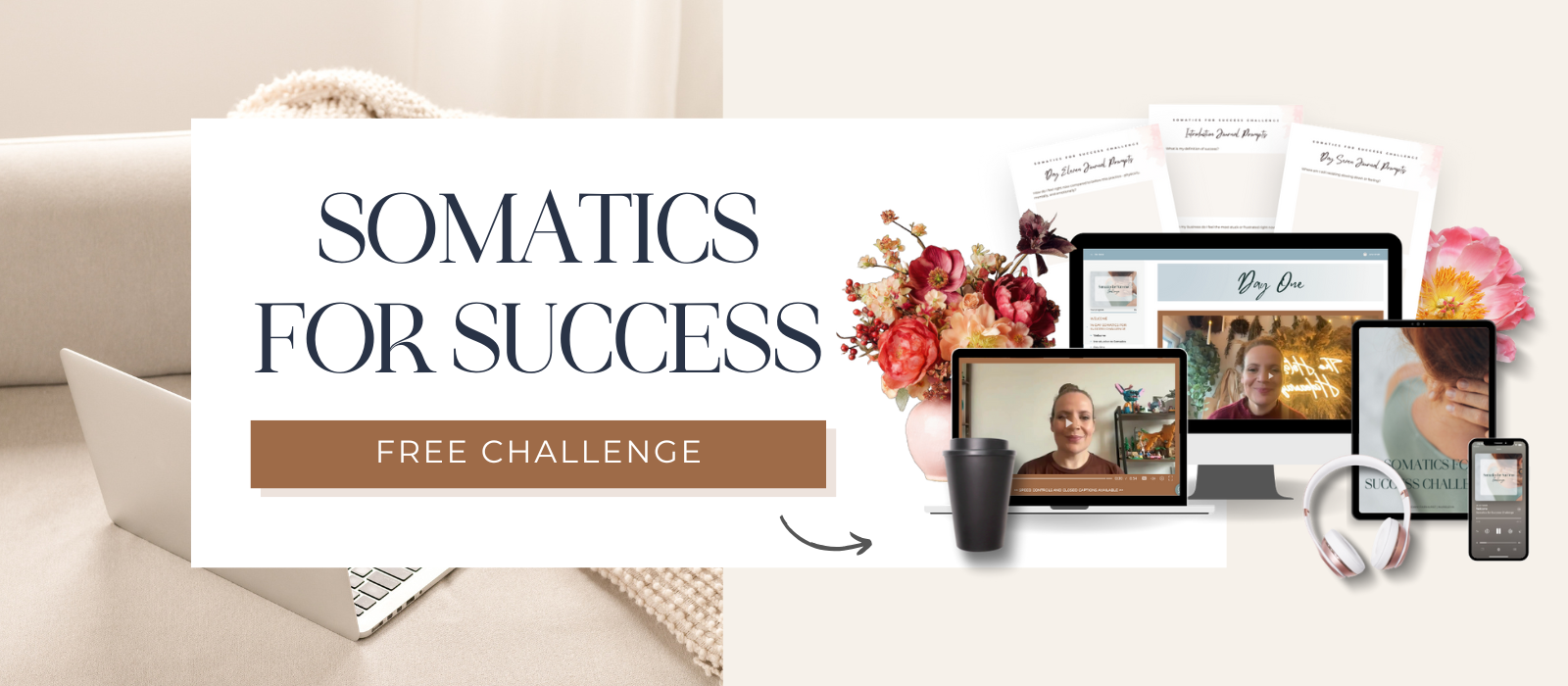
Your Next Step: The Free Somatics for Success Challenge
If this is resonating with you and you’re ready to experience what it feels like to move from frazzled to focus, I’ve created something to support you.
The Somatics for Success Challenge guides you through a different nervous system regulation practice each day. Each practice takes just 5-10 minutes and fits easily into real life. Over the 14 days, you’ll explore:
Grounding tools you can use anytime, anywhere.
Breathwork to calm your nervous system quickly.
Movement to release stored tension.
Body awareness to reconnect with your natural rhythms.
This post may contain affiliate links which means I may receive a commission if you purchase something through my link. I only recommend things I have used and love.
You know that feeling when you’re staring at your laptop, knowing you have a million things to do, but your brain feels like it’s wrapped in cotton wool?
Every decision feels harder than it should, your to-do list looks mildly threatening, and you’re constantly in “go mode” yet somehow seem to be getting less done than ever.
If this feels familiar, here’s something important you need to know: This isn’t a motivation problem, it’s not a mindset issue, and it’s definitely not because you’re lazy or lack discipline.
Your nervous system is running the show, and if it’s stuck in survival mode, it’s quietly sabotaging your business growth and success every single day.
What a Dysregulated Nervous System Looks Like in Business
Let’s get real about what’s happening in your body when you’re trying to build an online business. You wake up, check your phone (mistake #1), see seventeen notifications, three urgent emails, and a competitor who just launched something that makes your stomach drop.
Before you’ve even had a sip of coffee, your nervous system has clocked “threat”.
Your body shifts into fight, flight, freeze, fawn, or friend – a stress response designed to help us survive danger. The problem? Your nervous system doesn’t know the difference between a lion chasing you and an overflowing inbox.
Constant anxiety or tension
Overthinking every decision
Procrastination mixed with bursts of frantic productivity
Difficulty focusing or finishing tasks
Feeling “busy” but not effective
You’re not broken, your nervous system is simply prioritising survival over strategy.
How Stress Hijacks Creativity, Focus, and Decision-Making
When your nervous system is dysregulated, your brain literally can’t access the functions you need most as a business owner. Things like creativity, problem-solving, clear decision-making, and strategic thinking.
All of these live primarily in the prefrontal cortex – the part of the brain responsible for planning, reasoning, and innovation.
But when your body perceives a threat, your nervous system diverts energy away from this area and toward survival responses instead.
Put simply: A stressed nervous system shuts down your ability to think about business clearly.
That’s why you second-guess decisions that you know are right, simple tasks feel overwhelming, creative ideas dry up, and everything feels harder than it logically should. is overwhelmed.
What Nervous System Regulation Actually Means
Nervous system regulation isn’t about becoming a zen master or meditating for hours each day. It’s about teaching your body that it’s safe.
When your nervous system feels safe, your brain can come back online and do what it’s designed to do – innovate, create, and solve problems.
When you’re regulated, you’ll notice that you can:
Make decisions without spiralling into doubt.
Focus for longer periods of time.
Access creativity more easily.
Respond to challenges instead of reacting emotionally.
Recover faster from stress.
Think of your nervous system as the operating system of your business.
Your marketing, sales, content creation, and leadership all run on top of it. If the operating system is stressed and glitchy, nothing else works properly, no matter how good your strategy is.
The Science Behind Why Stress Blocks Business Growth
Chronic stress keeps cortisol levels elevated in the body, leading to something known as allostatic load – essentially the wear and tear caused by being on high alert for too long.
In business, this shows up as decision fatigue (even small choices feel exhausting), reduced working memory (forgetting ideas or tasks), loss of creative flow, and emotional reactivity.
On the other hand, people with better nervous system regulation recover from stress more quickly, maintain better focus, and slip into flow states more easily.
They’re not more talented. They’re not more disciplined. They’re not luckier.
They’re just working with their nervous systems instead of against them.
The Business Benefits of Nervous System Regulation
When you begin regulating your nervous system consistently, the shifts show up everywhere in your business.
Clearer Decision-Making You stop spending hours overthinking simple choices. Your inituition becomes easier to hear because stress isn’t drowning it out.
Increased Creativity Creative breakthroughs happen when your nervous system is calm enough to allow new connections to form, not when you’re forcing ideas under pressure.
Sustainable Energy Instead of crashing by mid-afternoon, your energy becomes steadier and more reliable throughout the day.
Improved Focus and Productivity Deep work becomes possible again when your nervous system isn’t constantly scanning for threats.
The Leadership Ripple Effect Most People Miss
Your nervous system state doesn’t just affect you, it affects everyone you interact with too.
When you’re dysregulated, that tension subtly spreads to clients, collaborators, and team members. When you’re regulated, you become an emotional anchor which leads to better collaboration, clearer communication, increased trust and confidence, and more grounded leadership.
Remember: people don’t just respond to your words, they respond to your nervous system.
From Reactive to Responsive: The Real Shift
The difference between business owners who thrive and those who burn out isn’t talent, effort, or luck. It’s the ability to respond instead of react.
When you’re regulated a negative comment doesn’t ruin your day, a tech issue becomes a problem to solve rather than a personal failure, comparison becomes information, not self-criticism, and setbacks become data points, not proof that you’re failing.
This shift alone can change how sustainable (and enjoyable) your business feels.
Simple Somatic Practices That Create Big Shifts
Nervous system regulation doesn’t require massive lifestyle changes. Small, consistent practices have the biggest impact.
Some of the most effective tools include:
Breathwork to signal safety and calm stress in minutes.
Gentle movement to release stored tension.
Intentional pauses between tasks to prevent overwhelm.
Co-regulation through calm, supportive connection.
Just a few minutes a day can completely change how your body experiences working on your business.
Why Nervous System Regulation Matters More Than Your Business Plan
You can have the best strategy in the world but if your nervous system is dysregulated, you’ll self-sabotage without even meaning to.
Procrastination. Second-guessing your decisions. Burnout.
When you work with your nervous system instead of against it, everything else becomes easier. Your capacity expands. Your intuition sharpens. Growth becomes sustainable instead of exhausting.
And this isn’t about adding more to your to-do list (because I know that’s already got more than enough on it!), it’s about strengthening the foundation everything else is built on.
If you’re reading this thinking, “This makes sense, but how do I actually start?” you’re in the right place!
This post may contain affiliate links which means I may receive a commission if you purchase something through my link. I only recommend things I have used and love.
There’s a particular kind of procrastination that doesn’t look like laziness at all.
It looks like showing up at your desk, opening the right tabs, making a strong cup of coffee, and genuinely intending to work… only to find yourself rearranging folders, rereading the same email, or suddenly deciding now is the perfect time to tidy something that absolutely did not matter five minutes ago.
On the surface, it looks like avoidance. Underneath, it’s something much more human. Very often, procrastination is your nervous system trying to protect you.
Not from the task itself, but from what the task represents – visibility, judgment, responsibility, or the emotional exposure that comes with taking the next step.
For online business owners, especially, work is rarely neutral. It carries identity, income, and self-worth all wrapped up together.
And your nervous system feels that.
Why Procrastination Isn’t a Willpower Problem
We’ve been taught to treat procrastination as a discipline issue. Something to override, fix, or power through. So when we get stuck, we look for better systems, stricter routines, or stronger accountability.
But this approach misses something fundamental.
Your nervous system’s primary job is not to make you productive, it’s to keep you safe.
When your system perceives a threat, whether real or imagined, it shifts your body into a survival response. Resources are redirected away from long-term planning, creativity, and nuance, and towards immediate protection.
This is why you can know what you need to do and still feel unable to do it.
It’s not that you don’t want success. It’s that part of your body doesn’t feel safe holding it yet.
The Nervous System’s Role in Focus and Follow-Through
From a physiological perspective, chronic stress pulls your nervous system into fight-or-flight. In this state, the prefrontal cortex (the part of your brain responsible for decision-making, focus, and creative thinking) receives less support.
Instead, your body prioritises vigilance.
This looks like:
Scanning for problems.
Anticipating what could go wrong.
Overthinking small decisions.
Difficulty sustaining attention.
It’s why ideas arrive when you’re relaxed – in the shower, walking, or half asleep – but disappear when you sit down to work.
Creativity and productivity require internal safety. Without it, your system keeps interrupting you with resistance, distraction or shutdown.
Procrastination isn’t a lack of motivation, it’s a sign that your nervous system is overwhelmed.
Why Somatic Practices Change the Game
Somatic practices work at the level of the body, not the intellect.
Instead of asking, “How do I make myself do this?”
They ask, “What does my body need to feel safe enough to engage?”
This is a subtle but powerful shift.
When your nervous system begins to regulate, your internal experience of work changes. Tasks feel less emotionally charged. Decisions become clearer. Your energy steadies instead of spiking and crashing.
You’re no longer fighting yourself to be productive, you’re supported from the inside and that leads to so much more – more flow, more creativity, more forward momentum… the list goes on!
The Internal Shifts You’ll Start to Notice
As regulation becomes part of your routine, productivity stops feeling like a battle.
Decision-making becomes more intuitive because stress no longer drowns out your inner signals. You spend less time analysing and more time acting from clarity.
Your energy evens out. Instead of frantic bursts followed by exhaustion, you develop a rhythm that allows consistent progress without burning out.
Creativity returns not because you’re forcing it (because we alllll know how that works out!), but because your nervous system feels safe enough to explore, play, and take risks again.
This is what sustainable productivity actually looks like.
Three Somatic Practices That Support Focus and Action
One of the most empowering things about somatic work is how accessible it is. These practices don’t require hours of time or special conditions – just a willingness to give it a go and consistency.
1. The 4-7-8 Reset Breath
Your breath is one of the fastest ways to influence your nervous system.
The 4-7-8 pattern lengthens your exhale, which signals safety and supports parasympathetic activation.
Using it before starting a task you’ve been avoiding will help your body soften its resistance and brings your brain back online.
This isn’t about calming down for the sake of calm, it’s about creating the conditions where focus becomes possible.
How to do it:
Inhale through your nose for a count of four.
Hold for a count of seven.
Exhale through your mouth for a count of eight.
Repeat for 5-10 rounds as needed.
2. Shake and Release
Modern life encourages us to suppress stress rather than discharge it.
Shaking is an instinctive way the body releases excess nervous system activation. By allowing gentle, rhythmic movement, you help your system complete the stress cycles that would otherwise stay stored as tension.
This practice is especially helpful when you feel mentally blocked or physically restless.
How to do it:
Start by shaking your hands and arms.
Let the movement travel through your body – your legs, your head, everywhere!
Continue shaking it out for 30-60 seconds.
Finish with three slow, grounding breaths.
3. The Body Scan Check-In
Disconnection from your body’s signals often precedes procrastination.
A short body scan brings awareness back to where tension is being held and invites you to respond to small needs before they become resistance.
This practice builds trust between you and your body, which is essential for sustained productivity.
How to do it:
Bring your awareness to each part of your body, starting with the top of your head.
Move down your body slowly, noticing anywhere you’re holding tension.
If you notice tension or discomfort, breathe into that area.
Ask, “What does my body need right now?”
Applying Somatic Awareness to Daily Business Life
When you begin relating to procrastination as information rather than failure, something important shifts. Instead of sprialling into self-criticism or trying to force yourself through resistance, you start getting curious about what your body is communicating.
That curiosity alone reduces a huge amount of internal pressure.
Everyday business tasks stop feeling like personal threats and start feeling like they actually are: actions that require capacity, clarity, and support.
Emails, for example, often carry far more emotional weight than they deserve. A busy inbox can feel like a constant stream of demands, expectations, and potential conflict. When your nervous system is already under strain, even opening a single email can trigger a stress response. Through somatic awareness, you begin to notice what’s happening in your body before you react – a tightening in your chest, shallow breathing, raised shoulders. By softening those physical responses first, email becomes a neutral task rather than something your body needs to defend against.
The same applies to everything we do as business owners from content creation to sales calls.
Another magical area is decision-making. Decision-making changes when you include your body as part of the process. Instead of analysing every option to exhaustion, you begin to notice how each choice feels internally. Tightness, contraction, or a sense of holding often signal pressure or misalignment. Ease, expansion, or a settled feeling in the body can indicate clarity or readiness. These sensations aren’t mystical or woo, they’re your nervous system’s way of processing information quickly and holistically. Often, your body knows what makes sense long before your mind catches up.
This doesn’t mean we abandon logic or strategy, it means we support them.
Somatic awareness gives your strategy somewhere to land. It creates the internal conditions where planning, creativity, and execution can happen without constant resistance. Instead of fighting yourself to get things done, you’re working in partnership with your nervous system and that changes not just how productive you are, but how sustainable your business feels over time.
The Wider Impact of Regulation
As your nervous system becomes more regulated, the effects rarely stay confined to your workday. They ripple outward into the rest of your life in subtle (and sometimes not so subtle) but meaningful ways.
You may start sleeping more deeply, not because you’re doing more, but because your body is finally learning how to downshift. Emotional resilience grows as everyday stressors stop knocking you off centre quite so easily. You become more present in your relationships, less reactive, more able to listen and respond rather than brace or withdraw.
Confidence also begins to change shape. Instead of being driven by hype, comparison, or the need to prove yourself, it settles into something quieter and steadier. A grounded sense of self-trust replaces the constant internal questioning. You’re no longer pushing yourself forward through force, you’re moving from a place of internal support, and that’s something truly beautiful!
Creating a Sustainable Somatic Practice
This work isn’t about doing everything perfectly or adding yet another thing to your to-do list. In fact, it works best when it’s simple.
Choose one practice, commit to it gently, and focus more on consistency rather than intensity or perfection. Pay attention to what shifts, not just in your productivity, but in how you feel in your body as you move through your day.
It’s important to remember that your nervous system adapted the way it did for very good reasons. Hypervigilance, tension, and avoidance once helped you cope, protect yourself, or get through difficult seasons. And regulation doesn’t delete that intelligence, but it updates it for your current reality (you know, the one where you’re not being chased by a predator).
If you’re curious about what this could look like, I’d love for you to join our free Somatics for Success Challenge.
Each day, you’ll be guided through a short somatic practice designed specifically for the realities of being an online business owner!
This post may contain affiliate links which means I may receive a commission if you purchase something through my link. I only recommend things I have used and love.
Why does success sometimes feel unsafe, even when it’s everything you’ve been working for?
In this epsiode of The Regulated Rebel Podcast, I’m diving deep into the sneaky ways your nervous system might be blocking you from expanding into your next level, and why that’s not your fault!
I share how our brains and bodies are wired for survival, not visibility, and how the simple act of showing up online, launching a course, or raising your prices can feel unsafe when your nervous system hasn’t yet learned that it’s okay.
You’ll hear:
✨ Why your nervous system sees “unknown” as “dangerous”, and how that impacts your business. ✨ How procrastination and perfectionism are actually safety strategies. ✨ Why traditional business advice can trigger burnout, and how to build calm, sustainable success instead. ✨ Learn a super simple breathwork practice you can use anytime to signal to your body: You’re safe. You’ve got this.
This episode is your permission slip to stop forcing, start breathing, and build success from a place of safety and calm.
Because when your body feels safe to succeed, you become UNSTOPPABLE.
If this episode resonated, share it to your Stories and tag me, I love seeing where you’re listening from! And if you’re feeling extra generous, leave a quick review on Apple Podcasts to help more sacred rebels find their calm.
This post may contain affiliate links which means I may receive a commission if you purchase something through my link. I only recommend things I have used and love.
When you’re stressed, what’s the first thing you do?
Maybe you tell yourself to “just calm down” (real helpful, btw!), maybe you push through, distract yourself with another coffee or an episode of something mindless on Netflix, or scroll social media hoping the tension will pass.
Or maybe you’re like so many ambitious, big-hearted business owners who go right into fix-it mode, trying to think your way out of it?
The problem is that these things never really work.
The #1 Mistake: Trying to Think Your Way Out of Stress
The number 1 mistake I see is people trying to mindset their way out of a stress spiral.
We’re told things like:
“Just change the way you think about things.” “Positive vibes only.” “Breathe and move on.”
But when your body is stuck in stress, no amount of rational thinking or gratitude journaling is going to pull you out of it. And if you’ve ever felt like a personal development failure because you “know better” but still feel like you’re drowning in overwhelm, just know, you’re not broken.
What’s Actually Happening
When you’re stressed, your nervous system shifts into fight-or-flight more. Your heart rate increases, your breathing becomes shallow, your muscles tense, your digestion slows, your brain becomes hyper-vigilant, and starts scanning for more threats.
And even after the stressful moment passes, your body can stay stuck in that loop.
It’s like the smoke alarm that continues to blare well after the toast has popped up.
This means that trying to “think positively” without regulating your nervous system is like trying to turn off the smoke alarm by whispering, “Everything’s okay” to it.
It doesn’t work because the part of you that’s in control (your survival brain) isn’t listening to logic, it’s listening to your body.
Why This Matters So Much for Business Owners
When you’re running a business, stress is kinda inevitable.
You’re navigating strategy, sales, visibility, client work, boundaries, and let’s be honest, your own inner critic who never takes a day off. And if your nervous system is constantly in high-alert mode, you’re not just stressed, you’re drained, reactive, foggy, and way more likely to self-sabotage.
The Cost of an Unregulated Nervous System in Business
Let’s talk about the real ripple effect:
You procrastinate on the exact things that would move your business forward (not because you’re lazy, but because they feel unsafe).
You freeze before launching, raising your prices, or pitching yourself because your body associates visibility with risk.
You crash after big pushes or launches, because you were riding on adrenaline the whole time.
You keep saying yes to things you know are a no, because your nervous system is wired to people-please for safety.
None of this makes you unmotivated or undisciplined (no matter how much the online business “gurus” will try to make you think you are). It means that your body is stuck in a protective loop. And if you don’t work with your nervous system, it will keep pulling the emergency brake no matter how much mindset work you do.
What To Do Instead: Regulate Your Body First
The secret to lasting stress relief (and sustainable business growth) isn’t more mindset work, it’s nervous system regulation.
You need a way to tell your body, “You’re safe now. You can let go.” That’s exactly what my 5-Minute Stress Reset Guide is designed to do. It combines breathwork, EFT Tapping, and affirmations to calm your nervous system fast so you can move forward with clarity, confidence, and focus.
Here’s why it works and why it’s so important for you as a business owner.
Breathwork = Instant Calm
Your breath is the fastest way to access your parasympathetic nervous system (the part responsible for rest, digestion, and healing). When you slow and deepen your breath, you tell your body: It’s safe to slow down.
This matters when you’re writing content, making decisions, or about to go live.
Calm breath = clear brain.
Tapping = Emotional Regulation
Tapping works on the body and the brain. It helps release stored stress, process emotions, and rewire the subconscious response. It’s like giving your nervous system a hug and saying, “We’ve got this.”
When you use it consistently, you start showing up with more ease and groundedness, even when things get wobbly.
Affirmations = Anchoring New Beliefs
There’s a catch when it comes to affirmations…they only really work once your body feels safe. Otherwise, your subconscious rejects them. That’s why I combine them with breathwork and tapping.
The Transformation That Happens When You Stop Making This Mistake
Once you start working with your nervous system instead of fighting against it, everything shifts:
You no longer feel hijacked by stress.
You stop spiralling after one triggering email.
You start recovering faster from tough moments.
You feel more empowered, present, and emotionally resilient.
And in your business?
You make bold moves without second-guessing.
You stop burning out after every launch.
You hold boundaries with clients (and yourself).
You create from a place of inspiration, not pressure.
This is what sustainable success actually looks like.
If you’ve ever felt like you’re doing all the things to manage your stress and still feel like it owns you, you’re not failing.
You’ve just been missing the piece that no one taught us in school – your nervous system has to come first.